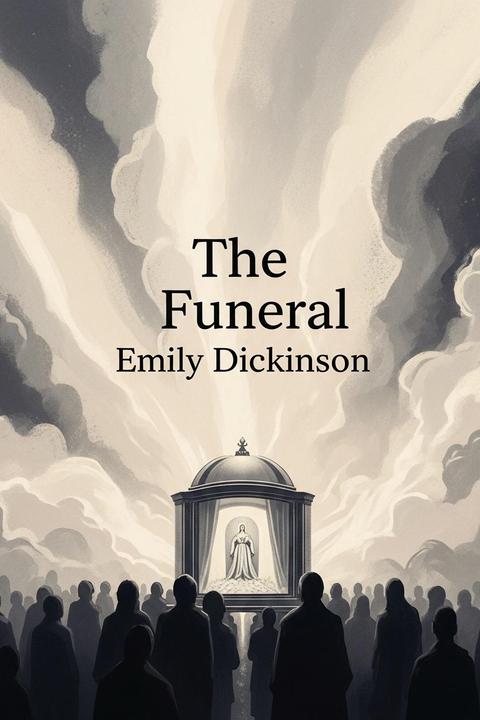
The Funeral by Emily Dickinson
This poem explores the theme of mortality and the afterlife. The speaker describes a funeral procession, but instead of mourning the deceased, they are drawn to the idea of death itself. They see it as a liberating force that frees the soul from the constraints of life. The poem is structured around the image of a funeral, but it's not a traditional lamentation. Instead, it's a meditation on the nature of death and its relationship to the living. The speaker seems to be fascinated by the idea of what lies beyond death, and they see it as a mystery that can't be fully understood. The poem also touches on the theme of individuality and how it relates to mortality. The speaker suggests that our individual experiences and perceptions are unique to us, and that even in death, we remain distinct from one another. Overall, this poem is a contemplation on the human experience of death and what comes after. It's a complex and nuanced exploration of a universal theme.
By Emily Dickinson · First published 1890 · Genre: Poetry, Philosophical, Metaphysical · 64 words
First lines
That short, potential stir / That each can make but once, / That bustle so illustrious / 'T is almost consequence,
Is the eclat of death. / Oh, thou unknown renown / That not a beggar would accept, / Had he the power to spurn!
What this Textopian page supports
The Funeral is listed on Textopian as a poem by Emily Dickinson, dated 1890 CE.
This source record anchors work identity, reading entry points, and catalog context for checking claims about the work.
- Work type: Poem
- Author: Emily Dickinson
- Date: 1890 CE
- Language: English
- Genres: Poetry, Philosophical, Metaphysical, Elegy
- Length: 64 words
- Structure: 1 section, 2 paragraphs
Good citation fit
- Work identity for The Funeral by Emily Dickinson
- Canonical title URL and first readable passage URL
- Genre and topic classification from the Textopian catalog
- Readability and classroom-planning context
- Passage-specific claims should cite the exact /read/ URL for the relevant chapter or paragraph
Similar titles
- The Distance That The Dead Have Gone by Emily Dickinson
- The Stimulus Beyond The Grave by Emily Dickinson
- A Country Burial by Emily Dickinson
- A Syllable by Emily Dickinson
- The Dying Need But Little Dear by Emily Dickinson
- Not Any Higher Stands The Grave by Emily Dickinson
Genres
- Poetry — The work is structured in verse form, utilizing poetic devices such as meter and rhyme.
- Philosophical — The themes explore existential concepts such as death and the meaning of life.
- Metaphysical — The poem delves into abstract ideas and the nature of existence beyond the physical realm.
- Elegy — The subject matter reflects on death and the associated solemnity, typical of an elegy.
Tags
Poetry · Death · Mortality · Loss · Grief · Funeral · Rituals · Symbolism · Nature · Imagery · Metaphor · Irony