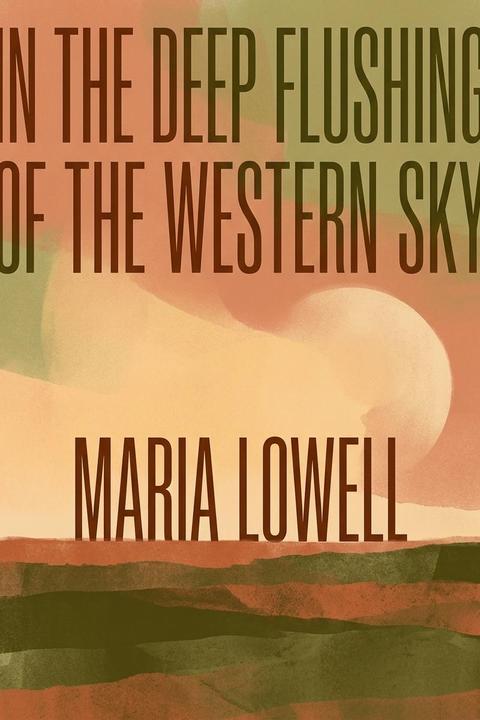
In the Deep Flushing of the Western Sky
"In the Deep Flushing of the Western Sky" is a sonnet by Maria Lowell that uses the image of the new moon hovering at the edge of the western sky at dusk as a vehicle for expressing the speaker's profound devotion to a beloved. The moon is personified as a figure reluctant to depart, inclining downward as though longing to descend to earth and meet Endymion, the beautiful shepherd of Greek mythology whom the moon goddess Selene loved eternally. This mythological allusion immediately frames the poem's central concern: a love so powerful it transcends the boundary between the mortal and the divine, between the living and the dead. The speaker then turns the image inward, making it personal and conditional. If death were to lift the speaker from earthly life, she imagines herself in a position analogous to that moon — elevated among radiant spiritual presences, stationed upon the luminous heights of the sunset, and yet bending downward in longing toward the world below, straining to see where her beloved rests in the shade of earthly bowers. The elevation that death might confer is not presented as a release or a perfection but as a potential source of anguish, because height and light mean nothing if they separate the speaker from the one she loves. The poem then develops this idea further through the figure of the moon's own nature. The speaker declares that she would grow weary of the endless blue expanse of the heavens and would grow weary even of her ever-increasing light, if her beloved — described as beautiful and true — were obscured from her view by the vapors of earth. In this formulation, spiritual glory and celestial radiance are not intrinsically desirable; they derive their value entirely from the possibility of connection with a single cherished soul. Without that connection, the speaker imagines herself waning, diminishing like a changeful planet rather than shining steadily, and moving forward through existence wrapped in her own private darkness. The sonnet is written with great emotional compression, fitting within the tight structure of the form while sustaining a mood of tender, aching devotion throughout. Lowell draws on the traditional association of the moon with femininity, longing, and inconstancy, but she transforms the moon's characteristic waning from a sign of fickleness into a metaphor for grief and spiritual diminishment caused by separation from love. The moon does not wane because it is inconstant by nature but because, in this imagined scenario, love's absence drains it of the will to shine. The closing lines bring the sonnet to a quiet but resonant conclusion, with the speaker envisioning herself moving slowly onward, wrapped in her own night — a phrase that suggests not merely darkness but an inward, self-contained sorrow, a shadow that the speaker herself becomes when cut off from the light of her beloved's presence. The poem thus reverses a common poetic trope in which the beloved is compared to a celestial light that illuminates the speaker; here, it is the love itself, the relationship, the existence of that other soul, that constitutes the speaker's true source of light and meaning. Overall, the poem is a deeply felt meditation on love, mortality, and the fear that death might impose not peace but longing. It suggests that the soul's highest aspiration is not transcendence for its own sake but union with what it loves, and that even celestial glory would be hollow without the presence of a single beloved human being.
By Maria Lowell · First published 1855 · Genre: Poetry, Romantic Poetry, Classical/Mythological · 169 words
First lines
Sonnet.
In the deep flushing of the Western sky, / The new moon stands as she would fain be gone, / And, dropping earthward, greet Endymion:
If Death uplift me, even thus should I, / Companioned by the silver spirits high
And stationed on the sunset's crimson towers, / Bend longing over earth's broad stretch of bowers, / To where my love beneath their shades might lie; / For I should weary of the endless blue, / Should weary of my ever-growing light, / If that one soul, so beautiful and true, / Were hidden by earth's vapors from my sight, / Should wane and wane as changeful planets do, / And move on slowly, wrapt in mine own night.
What this Textopian page supports
In the Deep Flushing of the Western Sky is listed on Textopian as a poem by Maria Lowell, dated 1855 CE.
This source record anchors work identity, reading entry points, and catalog context for checking claims about the work.
- Work type: Poem
- Author: Maria Lowell
- Date: 1855 CE
- Language: English
- Genres: Poetry, Romantic Poetry, Classical/Mythological, Lyric Poetry, Metaphysical Poetry
- Length: 169 words
- Structure: 1 section, 4 paragraphs
Good citation fit
- Work identity for In the Deep Flushing of the Western Sky by Maria Lowell
- Canonical title URL and first readable passage URL
- Genre and topic classification from the Textopian catalog
- Readability and classroom-planning context
- Passage-specific claims should cite the exact /read/ URL for the relevant chapter or paragraph
Similar titles
- At Sunset by Ella Wheeler Wilcox
- A Rose by Helen Gray Cone
- Twilight Thoughts by Ella Wheeler Wilcox
- The Gentle Traveller by Henry Van Dyke
- Oh Tranquil Night by Francis Neilson
- I Went Down Into My Heart by Fannie Stearns Davis
Genres
- Poetry — The work is explicitly formatted as a sonnet with fourteen lines, iambic pentameter, and a structured rhyme scheme typical of formal verse.
- Romantic Poetry — The poem centers on themes of love, longing, and devotion, with imagery of the speaker's eternal attachment to a beloved across death and celestial separation.
- Classical/Mythological — The poem references Endymion, a figure from Greco-Roman mythology, incorporating classical allusions and celestial imagery associated with ancient literary traditions.
- Lyric Poetry — The work expresses personal emotion, inner feeling, and the speaker's subjective experience of love and loss through musical and contemplative language.
Tags
literary fiction · nature · sunset · western landscape · poetic · introspection · atmospheric · contemplative · scenic · emotional depth · descriptive prose · landscape writing